

Written by Shannon Wise, MM, MS : Resident in Counseling

The beginning of the New Year holds great significance for many of us. Like a big reset button on the calendar, that bright and shiny January 1 date can offer the promise of starting fresh, making positive life changes, moving towards a new goal with determination. Some of us make New Year’s resolutions. Some of us might even keep them. Yet statistics show that resolution-keepers are in the minority. According to a recent US News and World Report,
“ The failure rate for New Year's resolutions is said to be an estimated 80% with most people losing their resolve and motivation just weeks later in mid-February,” (Hayworth, 2026).
80%? Those are some pretty tough odds.
Thankfully, this year I didn’t make a resolution. I decided to set an intention instead. During a community practice at the beginning of the month, people were invited to come forward, reach into a basket and draw out a star with a word written on it. Whatever that word was, we were asked to consider what it would mean for that word to serve as a personal guide for the year ahead. Closing my eyes, I reached in, ruffled my hand around a little, and pulled out a paper star with one word written in the middle:
peace
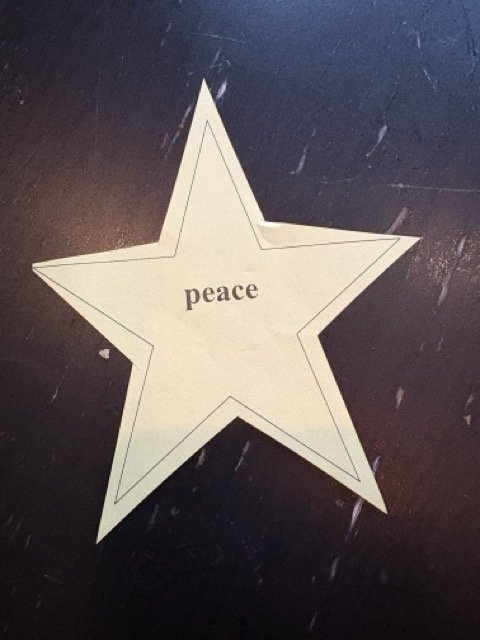
“Peace- OK,” I thought to myself. “That shouldn’t be too hard to practice.”
And I walked forward with my bright yellow peace star into the news blitz week of January 6, 2026.
It’s been a lot harder to focus on peace over the past few weeks than I thought it would be. In a month that in some ways feels longer than any other in recent memory, I’ve found myself admitting that I went into this whole peace thing with a far bigger ego than I realized.
As a wife and mom of 3, I’d navigated a lot of family conflict over the years, so I thought- “I’ve got this.”
As a therapist working with individuals, families and couples to find, nurture, and repair peace, I thought- “I can do this.”
But as an American citizen watching worsening events unfurl in the news each day- events full of anger, violence, and division, my confidence has been shaken. With inner alarm bells ringing on a daily basis from each new headline, I’ve been stuck between either wanting to avoid the news altogether or endlessly doomscrolling.
How do we find peace when it feels like the world is on fire?
The power of perspective
The older I get, the more I’ve learned that there are pivotal moments in life when we’re forced to take a pause and re-calibrate. Moments when we accept that we’re stuck emotionally and that we need a new map to follow. This month has marked one of those pivotal moments for me. My peace star was supposed to be my compass, but the path forward is one that I’ve never encountered before. I’ve been stuck in anxiety, needing to zoom out for a wider view. Somehow I needed to re-think the word “peace” and what it meant to move towards that value in a world that was anything but peaceful.
In Acceptance and Commitment Therapy (ACT), this process of zooming out is called “Cognitive Defusion”. Used to help manage distressing emotions,
“Cognitive defusion plays a vital role in building emotional resilience because it changes the way we relate to our internal experiences. Instead of being overwhelmed by difficult thoughts and emotions, defusion equips us with the psychological flexibility to move through life’s challenges with steadiness and self-awareness,” (Daniel, 2025).
Realizing I was overwhelmed, I remembered to pause. When I took a breath and took a step back from my anxiety, I began to see “peace” in a bigger, broader way- one that still felt relevant even in our country’s current situation.
Greg Levoy writes, “Up close, you see only the trees. From a distance, you see the forest. Or as Ralph Waldo Emerson once said, “The health of the eye seems to demand a horizon.” And the same goes for the psyche,” (Levoy, 2023)
Looking out from this wider lens, I had an epiphany:
What if peace was less about feeling “peace because of” and more about finding “peace in spite of?”
Less like the calm sea on a sunny day fantasy and more like the anchor in the stormy dark waves of reality?
What if peace had to begin with me?
There’s a song I learned as a child that talks about this:
“Let there be peace on earth,
and let it begin with me;
Let there be peace on earth,
The peace that was meant to be”
Somehow I’ve found myself humming this tune a lot as I’ve tried to take in this new view. Finding this reframe has felt like discovering a doorway from a tiny, low-ceilinged room into a tall, open atrium. I can breathe and move around a little more easily, feeling at times almost…. peaceful. I feel steadier now, and I can see more choices ahead.
This epiphany highlights one of the core concepts of Acceptance and Commitment Therapy: psychological flexibility.
“Psychological flexibility is like learning how to paddle your boat effectively, regardless of the conditions that are ever changing and out of your control. It’s what allows us to stay engaged with the things that matter most, even when the water gets choppy,” (Redner, 2025).
Letting peace begin with me has become my daily practice- a flexible, ever changing one that helps me find stability no matter what pops up on my news feed. When so much of what is happening leaves me feeling powerless, personal peace is something I can choose, in small intentional ways and tangible actions every day.
Peace In Practice:
We all have our personal peace practices. These are the things we find ourselves reaching out for when we need comfort in times of inner turmoil. A soft blanket. A scented candle. A hug. A quiet walk in nature. A conversation with a supportive loved one. The fellowship of a faith community. These small practices can help re-center and re-connect with a sense of calm and clarity when we feel overwhelmed.
Other suggestions:
Peace Online: Set a timer when you go on your phone to read the news or go on social media. Tune into your emotions as you engage with the content, noticing when the inner shift happens from calm to anxious, from peaceful to turbulent. Stop the timer at that moment, and note the length- this is your current capacity limit, your re-set point and signal to put the phone aside and re-engage in the present moment. Re-connecting with your senses and your surroundings to regulate your emotions and restore your personal peace.
Peace List:- Take a few moments to think about what feels comforting when you feel your inner storms start to rise, and make a list of what helps to soothe your spirit in those moments. Post the list somewhere visible and easily accessible to reference in moments of dysregulation. This practice can be especially helpful as a family activity, encouraging each member to make their own list and share it with each other, noting practices that can be done at home, at school, or at work.
Peace Practice: Breath prayer/meditation
Regulating the breath is a powerful and immediate way to regulate emotion, reducing the adrenaline response and restoring inner balance.
Find Stillness: Sit or lie comfortably, close your eyes, and take a few deep, slow breaths to center yourself.
Choose Your Phrase: Select a short phrase, typically two parts, that resonates with your spiritual tradition or current need.
Repeat & Focus: Continue for several minutes, gently bringing your focus back to the phrase and breath if your mind wanders.
Example:
Part 1 (Inhale): a source of comfort or concept of receiving- “Source of peace”
Part 2 (Exhale): a need or release- “give me strength”, “release my fears”,
Synchronize Breath & Words:
Inhale (slowly through the nose) saying the first part of your phrase.
Exhale (slowly through the mouth) saying the second part.
Peace in Music:
Peaceful music means something different to different people. Lower volume, slower rhythms, gentle sounds, all help to regulate the nervous system and lower the stress response. Soft instrumental music or vocals with soothing or uplifting lyrics. Create a peace playlist that can be played in the car, before you go to sleep- anytime you need to slow down your breathing and restore your sense of calm.
Listen: By Love, And by Beauty- Kim Robertson
https://www.youtube.com/watch?v=lGgwhpV2gEo
Wherever, and however you find your peace, know that you are not alone on the journey, and know that even the smallest step can make a big difference. In a time when peace feels fragile and out of reach, we can cultivate that light within ourselves that can guide our path, and serve as a light for others.
“There is no path to peace. Peace is the path.”
Ghandi
Resources:
Daniel, E. (2025, May 15). Embracing cognitive defusion for emotional resilience. The Harvest Clinic. https://www.harvestclinic.com.au/post/embracing-cognitive-defusion-for-emotional-resilience
Hayworth, J. (2026, January 10). Struggling to keep your New Year’s resolutions? Here’s how to keep yourself on track. ABC News. https://abcnews.go.com/US/struggling-new-years-resolutions-track/story?id=96173041#:~:text=According%20to%20research%2C%20Rook%20Williams,the%20drain%20on%20January%202nd.%22
Levoy, G. (2023, February 28). Zooming out: The power of putting things in perspective. Psychology Today. https://www.psychologytoday.com/us/blog/passion/202302/zooming-out-the-power-of-putting-things-in-perspective
Redner, S. (2025, January 23). Cultivating psychological flexibility with acceptance and commitment therapy. Inner Becoming. https://www.innerbecoming.com/blog/psychological-flexibility